
The Board of Deputies of British Jews has been awarded a government grant together with Catholic organisations to develop specialist teaching tools on antisemitism for Catholic schools.
The resources will equip pupils to recognise and challenge antisemitism, including harmful myths and conspiracies circulating on social media and online gaming platforms. They will also support teachers in delivering accurate, empathetic lessons on Jewish identity, diversity and lived experience.
Funded by the Department for Education, the initiative will be delivered by the Board of Deputies, the Archdiocese of Birmingham’s education service and the Catholic Education Service (CES).
It will feature resources for teachers including lesson guides and videos, for integration into Religious Education (RE), personal, social, health and economic (PSHE), and citizenship lessons.
The Board of Deputies will ensure that the resources are grounded in lived experience and best practice.
President of the Board of Deputies Phil Rosenberg said: “It is vital that schools teach young people to recognise and reject antisemitism. The Board of Deputies is proud to work with the Archdiocese of Birmingham and the Catholic Education Service to develop resources for Catholic schools, that will also help teachers deliver accurate, empathetic education about Jewish identity. We are grateful to the Department for Education for funding this important pilot, which has the potential to be scaled across the wider Catholic school community. I would also like to pay tribute to the commitment of the Catholic Church to taking real and meaningful steps to educate children against antisemitic hate.”
The Most Rev Bernard Longley, Archbishop of Birmingham and consultor to the Holy See’s Commission for Religious Relations with the Jews, and the Rt Rev Marcus Stock, Bishop of Leeds and Chairman of the CES, said in a joint statement: “One of the most fundamental Biblical teachings is that each one of us is made in the image and likeness of God.
“In Catholic schools 10% of curriculum time is dedicated to Religious Education, meaning alongside Catholic Christianity other religions like Judaism, Islam, Sikhism and world views are given more study time than in most non‑denominational schools, contributing to community cohesion.
“The Catholic education sector within the Archdiocese of Birmingham therefore welcomes this opportunity to work in partnership with the Board of Deputies of British Jews on a pilot initiative to help benefit schools and communities at a time of heightened tensions across the country.”
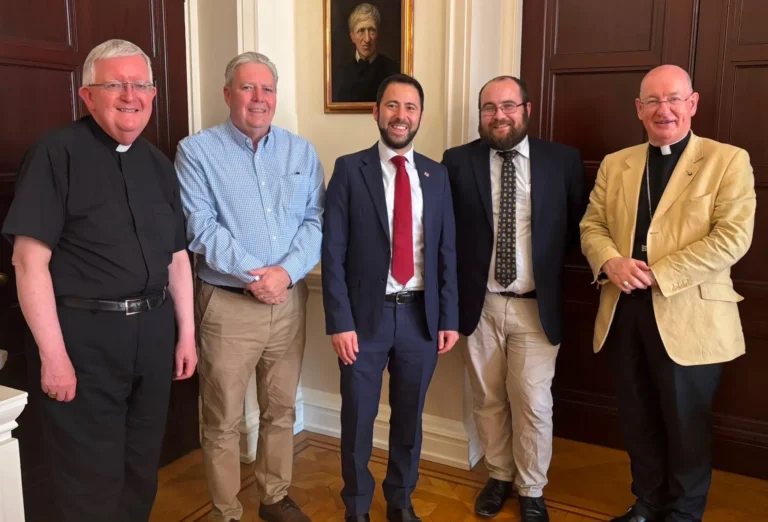
Photo: (left to right) Archbishop of Birmingham Bernard Longley, Executive Director of the Catholic Bishops’ Conference of England and Wales Gregory Pope, Board of Deputies President Phil Rosenberg, Board of Deputies Interfaith and Social Action Officer Daniel Epstein O’Dowd and Archbishop of Westminster Richard Moth